Commerce as Culture: Kurdish-American Entrepreneurs Who Are Making Heritage a Living
When Shirin Azizi opened her specialty food import business in Nashville five years ago, she was not simply trying to fill a gap in the local grocery market. She was trying to reconstruct something she had been losing, piece by piece, since her family arrived in Tennessee from the Kurdistan Region of Iraq nearly two decades earlier. The dried sumac, the black cumin, the particular variety of dried fig her grandmother once pressed into the palms of visiting neighbors—these were not mere ingredients. They were coordinates on a map of memory.
"Every time someone walks into my shop and smells the spices," Azizi says, "I can see something happen in their face. For Kurdish customers, it is recognition. For American customers, it is curiosity. Both of those reactions are exactly what I was hoping for."
Azizi is part of a quiet but consequential movement unfolding in Kurdish-American communities from San Diego to Nashville, from Houston to the suburbs of Chicago. Entrepreneurs are building businesses that place cultural identity not at the margins of their brand, but at the very center of it. And in doing so, they are discovering that authenticity, far from being a liability in the American market, can be among the most compelling assets a business owner possesses.
From Kitchen Tables to Commercial Ventures
The pathway from cultural practice to commercial enterprise is rarely linear. For many Kurdish-American entrepreneurs, a business begins not with a formal plan but with a persistent need—a community that cannot find what it is looking for, or a skill that has no obvious home in the mainstream economy.
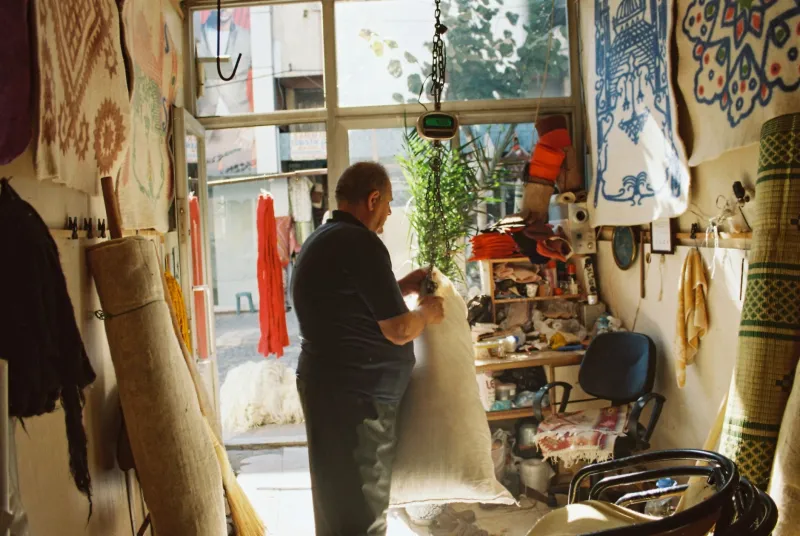
Dilnoza Mahmoud launched her textile and home goods studio in the Detroit metropolitan area after spending years watching her mother's intricate kilim-weaving techniques go unrecognized outside the family. What began as a small online shop selling hand-embroidered cushion covers and wall hangings has grown into a studio that now collaborates with interior designers and consults with cultural institutions on exhibition design.
"The American market responds to story," Mahmoud explains. "When I tell a customer that this pattern is specific to a village in the Duhok region, that it has been passed down through women in my family for four generations, the object changes for them. It stops being décor and becomes something else entirely."
This narrative dimension—the ability to attach deep cultural context to a product or service—is one of the defining characteristics of Kurdish-American entrepreneurship at its most successful. It is also one of the more delicate balancing acts these business owners must perform.
Navigating Authenticity and Market Demand
The American consumer landscape rewards differentiation, but it also exerts constant pressure toward simplification. Kurdish culture, which spans multiple countries, languages, and centuries of distinct regional traditions, does not always translate neatly into the kind of clean branding that digital marketing platforms favor.
Razan Khalil, who runs a consulting firm in the Chicago area specializing in cross-cultural communication for nonprofits and corporations, describes this tension with clarity. "There is always a temptation to flatten the complexity—to say 'Middle Eastern culture' when you mean something far more specific. I have made a deliberate choice to resist that. My clients hire me because I bring a particular expertise, and that expertise is rooted in a particular place and history."
Khalil's insistence on specificity has not narrowed her client base; if anything, it has distinguished her in a crowded consulting field. She notes that organizations working with Kurdish refugee communities, or seeking to expand services into diaspora neighborhoods, actively seek consultants who can provide granular cultural knowledge rather than generalized regional overviews.
The same principle applies across industries. Aryan Suleiman, who co-founded a Kurdish-language digital media company based in Northern Virginia, built his platform on the premise that a diaspora audience deserves content that speaks to its actual experience—not a diluted version of it. "There are millions of Kurdish people in this country who are navigating American life while also holding onto something that the mainstream media has no framework for," he says. "We exist to serve that specific audience, and that specificity is our entire value proposition."
Building Community Through Commerce
One of the more striking aspects of Kurdish-American entrepreneurship is the degree to which individual businesses function as community infrastructure. Specialty food shops become gathering spaces. Textile studios host cultural workshops. Media platforms organize community forums. The line between enterprise and cultural institution is, in many cases, deliberately blurred.
This dual function is not accidental. Many Kurdish-American entrepreneurs describe a conscious sense of obligation—a feeling that their business success carries responsibilities that extend beyond their own households. In communities where formal cultural institutions are still developing, a well-established small business can fill a significant gap.
Shirin Azizi's Nashville spice shop, for instance, now hosts monthly cooking demonstrations that draw both Kurdish families and curious neighbors from across the city. The events are part outreach, part education, and part business development. "I want Nashville to understand where this food comes from," she says. "Not just geographically, but culturally. The food is a door."
This model—using commerce as a vehicle for cultural education—reflects a broader strategy that several Kurdish-American entrepreneurs have adopted with notable success. By positioning their businesses as points of genuine cultural exchange rather than simply ethnic-market retailers, they are building customer relationships that carry a depth uncommon in transactional commerce.
The Visibility Dividend
The economic success of these ventures carries implications that reach well beyond any individual entrepreneur's balance sheet. In communities that have historically struggled for recognition in American public life, a visible and thriving Kurdish-owned business sends a message that resonates far beyond the marketplace.
"When young Kurdish kids in this city see my name on a storefront, see my work in a magazine, see my company mentioned in the local business press, something shifts for them," says Dilnoza Mahmoud. "They understand that their heritage is not something to hide or minimize. It is something that can carry them forward."
This visibility dividend—the way that individual entrepreneurial success compounds into broader community confidence—may be the most enduring contribution of this generation of Kurdish-American business owners. They are not only building enterprises; they are demonstrating, in the most practical terms possible, that cultural identity and economic ambition are not forces in opposition. They are, in the right hands, a formidable combination.
The work is neither simple nor without risk. Markets shift. Authenticity can be commodified. Communities evolve in ways that complicate the stories businesses tell about themselves. But the Kurdish-American entrepreneurs reshaping their industries are, by and large, approaching these challenges with the same resourcefulness that has defined Kurdish cultural survival across generations—and finding, in the American marketplace, an audience more ready to listen than they ever expected.
