Qahwah and Kinship: How Kurdish Families Are Keeping the Coffee Ceremony Alive Across America
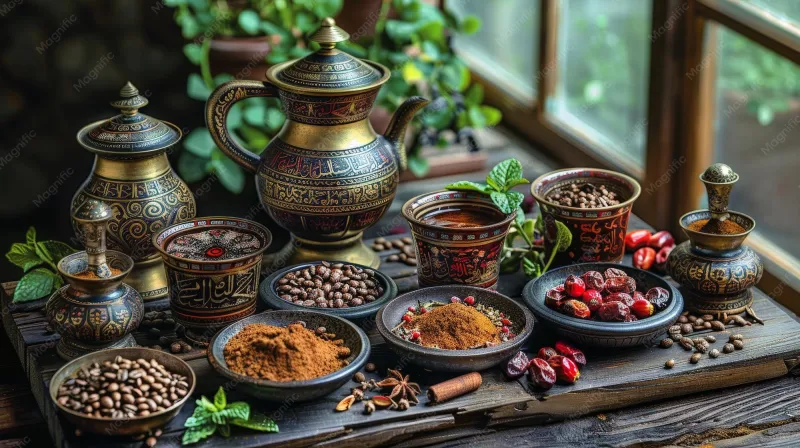
Photo: Kurdish traditional coffee ceremony cardamom brass dallah family gathering, via img.freepik.com
On a quiet Saturday morning in a suburb of Nashville, Tennessee, the scent of cardamom drifts through an apartment that could belong to any American family. But step inside, and the scene is unmistakably Kurdish. A brass dallah — the long-spouted coffeepot — sits warming on a small flame. A circle of relatives, ranging from white-haired grandparents to teenagers in hoodies, arranges itself around a low table draped in an embroidered cloth. The host, Nasrin Mahmoud, a 54-year-old Kurdish-American woman who emigrated from the Duhok region of Iraqi Kurdistan in 1998, pours the first small cup with deliberate care. Nobody reaches for their phone. Nobody rushes.
This is qahwah — the Kurdish coffee ceremony — and for millions of Kurds scattered across the United States, it remains one of the most powerful threads connecting diaspora life to ancestral homeland.
More Than a Morning Beverage
To describe qahwah simply as coffee would be to describe a symphony as background noise. The Kurdish coffee tradition carries centuries of social, spiritual, and diplomatic weight. Historically practiced across the broader Kurdish geographic homeland — spanning parts of present-day Iraq, Turkey, Iran, and Syria — the ceremony has served as a forum for resolving disputes, welcoming strangers, sealing agreements, and honoring the deceased. Its preparation is deliberate, its serving is structured, and its consumption is communal.
Traditional qahwah is prepared with lightly roasted green or yellow coffee beans, ground coarsely and simmered with generous amounts of cardamom and, in some regional variations, saffron or cloves. The result is a pale, aromatic brew — nothing like the dark espresso that dominates American coffee culture. It is served in small handleless cups called finjan, and the host typically pours and repours throughout the gathering, reading the mood of the room and ensuring no guest sits with an empty cup.
The act of refusal also carries meaning. Guests signal they have had enough by gently shaking the finjan from side to side before returning it — a gesture that, to the uninitiated, might seem like nervous fidgeting but is, in fact, an eloquent piece of cultural vocabulary.
Regional Variations Within a Unified Practice
Kurdish communities are not monolithic, and neither is their coffee culture. Kurds from the Badini-speaking regions of Iraqi Kurdistan tend to prepare qahwah with a heavier hand of cardamom and may include dried rose petals during celebratory occasions. Kurds with roots in the Sorani-speaking areas sometimes incorporate a subtle sweetness through the addition of sugar served separately alongside the cup, allowing each guest to adjust to personal preference. Among Kurdish communities with ties to southeastern Turkey, the ceremony may more closely resemble the broader Middle Eastern tradition of unsweetened bitter coffee served as a sign of hospitality.
In America, these distinctions have not dissolved — they have, in many cases, become a source of pride and playful negotiation. At community gatherings in cities with large Kurdish populations, such as Nashville (home to one of the largest Kurdish-American communities in the country), Lincoln, Nebraska, and parts of the San Diego metro area, families from different regional backgrounds often share their respective preparations, turning the coffee table into an informal cultural exchange.
Hosting as an Act of Preservation
For Nasrin Mahmoud, the weekly coffee gathering she hosts is not a nostalgic indulgence — it is a deliberate pedagogical act. "My grandchildren were born here," she explains, pouring a second round into the small cups. "They speak English better than Kurdish. But when they sit in this circle, they are learning something that no classroom can teach them. They are learning who we are."
Nasrin's daughter, Dilan, 29, who works as a nurse in Nashville, admits that she initially resisted what she called the "formality" of the ceremony as a teenager. "I thought it was old-fashioned," she says with a candid laugh. "But after I had my own children, something shifted. I started to understand that this is how we stay together — not just as a family, but as a people."
Similar stories echo across the country. In Lincoln, Nebraska, Soran Aziz, a 47-year-old Kurdish-American contractor, hosts a monthly qahwah gathering that has grown from an intimate family ritual into a neighborhood institution. What began with six relatives around a kitchen table now draws up to thirty participants, including non-Kurdish neighbors and colleagues who have been welcomed into the circle. "Hospitality is the whole point," Soran notes. "Qahwah is how we say: you matter, your presence matters, sit down and be with us."
Adapting Without Abandoning
Preserving a ceremony in diaspora inevitably requires adaptation, and Kurdish-American hosts are navigating that tension with remarkable creativity. The brass dallah, once purchased only through specialty import shops, is now available through online retailers catering to Middle Eastern communities. Green coffee beans — harder to source than conventional roasted varieties — are increasingly available through Arab and Kurdish grocery stores that have opened in cities with significant diaspora populations, as well as through specialty online vendors.
Some younger Kurdish-Americans have begun documenting the ceremony on social media platforms, sharing step-by-step preparation videos and hosting virtual qahwah sessions during the COVID-19 pandemic years — a development that initially surprised elders but ultimately helped extend the tradition's reach to second- and third-generation Kurds living far from established diaspora hubs.
Cultural organizations, including Kurdish community centers in Nashville and San Diego, have incorporated qahwah ceremonies into their public programming, offering demonstrations and participatory sessions that introduce the tradition to broader American audiences while affirming its significance within the community.
A Ceremony That Speaks Without Words
What strikes outside observers most forcefully about the Kurdish coffee ceremony is what it demands: presence. In an era defined by distraction and digital fragmentation, qahwah insists on eye contact, on listening, on the patient act of sitting with another person long enough to share something warm.
For Kurdish-Americans navigating the dual pressures of assimilation and identity preservation, the ceremony offers a third way — neither wholesale abandonment of heritage nor rigid isolation from American life. It is, instead, a practice of translation: taking something ancient and making it legible, and meaningful, in a new context.
As Nasrin refills the finjan one final time and the conversation around her table shifts from Kurdish to English and back again, the ceremony continues its quiet, essential work. Not merely preserving a cultural artifact, but sustaining the relationships, the memory, and the sense of collective selfhood that make a community more than a geographic coincidence.
In that cardamom-scented living room in Nashville, Kurdistan is not a distant homeland. It is present, poured carefully into a small cup, and passed hand to hand.