Beyond the Margins: Kurdish-American Women Artists Who Are Writing Themselves Into the Story
For much of the twentieth century, the dominant images of Kurdish women in Western media fell into two narrow categories: the silent victim of geopolitical violence, or the celebrated fighter — the Peshmerga or YPJ combatant photographed in military gear, her story reduced to a symbol of resistance useful to outside narratives. What was consistently absent was the full, complicated, generative interior life of Kurdish womanhood: its humor, its grief, its creative ambition, its contradictions.
That absence is being actively and loudly contested by a generation of Kurdish-American women who have chosen art as their primary instrument of self-definition. Across disciplines — visual art, poetry, documentary filmmaking, and music — these creators are producing work that refuses simplification, insisting on the complexity of Kurdish female experience while speaking to audiences far beyond their own communities.
Painting Memory Into Being
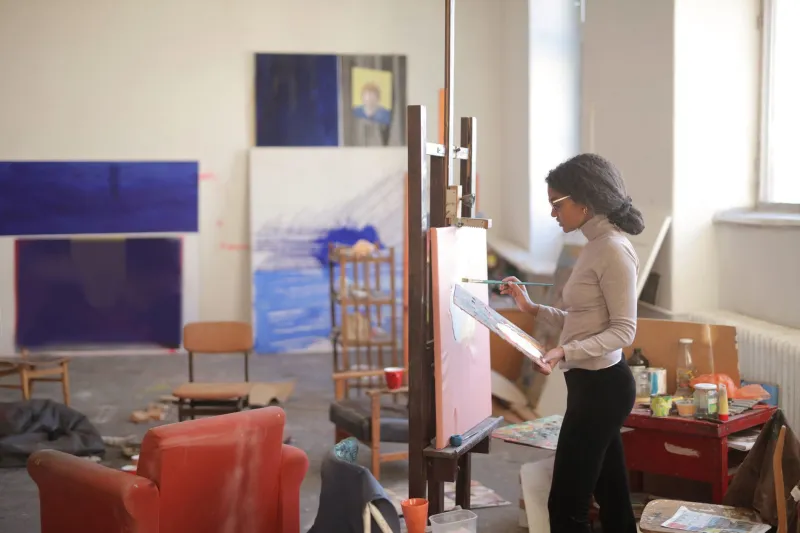
Shireen Kader grew up in the San Diego suburb of El Cajon, a city that has become one of the most significant hubs of Middle Eastern diaspora life in the United States. Her parents arrived from the Kirkuk region of Iraqi Kurdistan in the mid-1990s, carrying what she describes as "the weight of everything they couldn't bring with them." Kader, now 34, is a visual artist whose large-format paintings explore the landscape of memory — specifically, the way inherited trauma and inherited beauty coexist in the psyche of second-generation immigrants.
Her most acclaimed series, Soil Memory, features sweeping canvases that layer Kurdish geometric textile patterns — the kind found on traditional kilims and headdresses — over abstracted imagery of displacement: fragmented maps, half-legible script, figures that appear to be simultaneously arriving and departing. The work has been exhibited at galleries in Los Angeles and Chicago, and Kader recently received a grant from a national arts foundation to develop a site-specific installation for a Kurdish cultural festival in Nashville.
"I spent years feeling like I had to explain myself before I could make art," she says during a studio visit. "Like I needed to provide context for American audiences before they would accept my work as legitimate. At some point I stopped doing that. The art is the context."
This refusal to preemptively justify or translate Kurdish experience for Western consumption is a defining posture among many Kurdish-American women artists of Kader's generation — a deliberate assertion that their cultural reference points are not obscure but simply unfamiliar, and that the burden of unfamiliarity belongs to the viewer, not the artist.
Poetry as Political Act
In Nashville, poet and essayist Lanya Barzani has built a following that extends well beyond the Kurdish diaspora community. Her debut collection, published by an independent press in 2022, draws on Kurmanji oral poetic traditions — particularly the dengbêj, the ancient Kurdish tradition of storytelling through song and verse — while employing the rhythms and vernacular of contemporary American English. The resulting work is formally innovative and emotionally devastating, moving between languages, landscapes, and generations with the ease of someone who has spent a lifetime negotiating between worlds.
Barzani's poems frequently center on Kurdish women who have been erased from official histories: grandmothers who survived the Anfal genocide, mothers who rebuilt lives in refugee camps, aunts who arrived in America with nursing degrees that American licensing boards refused to recognize. These are not elegies, however. They are, as Barzani herself puts it, "acts of restoration."
"The dengbêj tradition was always about keeping people alive through language," she explains. "When communities were scattered, when archives were destroyed, the voice was the archive. I think of my writing as continuous with that tradition, even though the form looks completely different."
Barzani has also become a prominent voice in conversations about the representation of Middle Eastern and Kurdish communities in American literary culture, contributing essays to national publications and participating in panel discussions at universities and literary festivals. Her advocacy extends to mentoring younger Kurdish-American writers, many of whom have told her that encountering her work was the first time they felt that their specific experience was visible in American letters.
Filmmaking as Counter-Archive
Documentary filmmaker Dara Rashid has spent the past decade building what she calls a "counter-archive" of Kurdish women's stories. Based in Brooklyn, New York, Rashid — whose family has roots in the Mahabad region of Iranian Kurdistan — has directed three feature-length documentaries that have screened at independent film festivals across the country, earning awards at festivals in Austin and Seattle.
Her most recent film, What the River Remembers, follows four Kurdish-American women across three generations as they navigate questions of identity, belonging, and cultural inheritance in communities as geographically dispersed as Lincoln, Nebraska, and Dearborn, Michigan. The film has been praised by critics for its refusal to position its subjects as either victims or symbols, instead granting them the narrative space to be fully human — funny, contradictory, ambitious, uncertain.
"Every time a Kurdish woman appears on screen in mainstream American media, she's either suffering or she's heroic in a very specific, palatable way," Rashid observes. "My films are interested in everything in between. The ordinary extraordinary of a life."
Rashid is currently in pre-production on a project that will explore the intersection of Kurdish musical heritage and contemporary American hip-hop, a subject she came to through her own experience growing up listening to both traditional Kurdish dengbêj recordings and American rap in the same household.
Music at the Crossroads
That musical intersection is territory that Solin Aziz, a 27-year-old musician and producer based in Chicago, is exploring with particular urgency. Aziz performs under her given name and creates music that layers traditional Kurdish instruments — the saz, the duduk, hand percussion — beneath production techniques drawn from R&B, electronic music, and indie folk. Her self-produced EP, released independently in 2023, accumulated tens of thousands of streams and earned her invitations to perform at cultural festivals and college campuses across the Midwest.
For Aziz, music is simultaneously personal and political. Several of her songs address the experience of being Kurdish and female in America — the hypervisibility that comes with wearing a hijab in some contexts, the invisibility that comes with being part of a community that most Americans cannot locate on a map. "People hear the saz and they stop," she says. "That unfamiliar sound makes them actually listen. And once they're listening, I can say whatever I need to say."
A Movement, Not a Moment
What unites Kader, Barzani, Rashid, Aziz, and the many other Kurdish-American women artists working across the country is not a shared aesthetic or a unified political program. It is, rather, a shared refusal: the refusal to be defined exclusively by victimhood, by conflict, by the expectations of either mainstream American culture or, at times, their own diaspora communities.
These artists are not simply representing Kurdish identity — they are actively constructing new forms of it, forms capacious enough to hold the full weight of their experience. In doing so, they are contributing not only to Kurdish cultural life in America but to the broader, ongoing project of making American culture genuinely reflective of all the people who inhabit it.
At Rojda, we believe that cultural preservation is not a passive act. It is creative, contested, and alive. The work of these women is proof of that — and it demands to be seen.