Roots and Remedies: Kurdish-American Herbalists Are Bringing Ancestral Botanical Wisdom Into the American Wellness Conversation

Photo by Photo by Timothé Durand on Unsplash on Unsplash
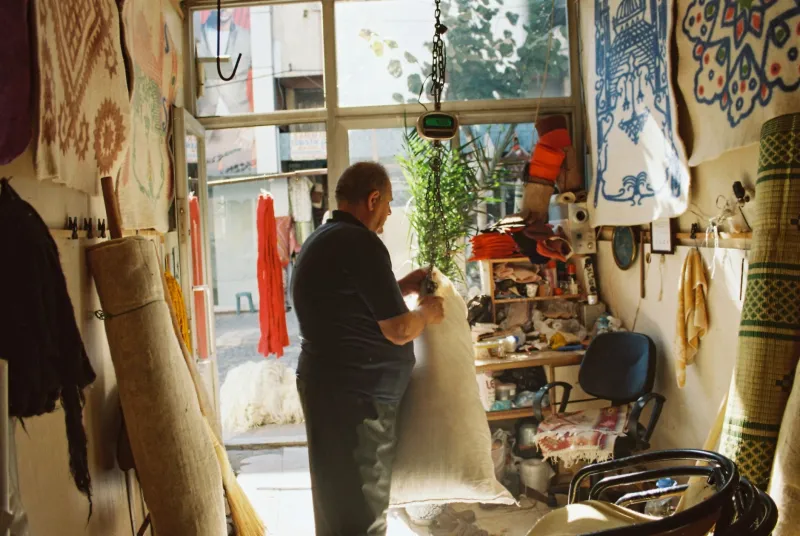
In a modest storefront tucked between a nail salon and a halal grocery in Nashville, Tennessee, the air smells of dried chamomile, sumac leaf, and something earthy that is difficult to name but immediately familiar to anyone who has spent time in a Kurdish grandmother's kitchen. Shelves line the walls from floor to ceiling, stocked with carefully labeled glass jars. The woman behind the counter can speak with equal fluency about the anti-inflammatory properties of black seed oil and the specific mountain valley in northern Kurdistan where her mother first taught her to identify wild thyme by touch.
This is not a scene from another era. It is happening now, in American cities from Nashville to San Diego, from Detroit to Dallas — wherever Kurdish communities have planted roots deep enough to begin looking backward as well as forward.
Knowledge Carried in the Body
For Kurdish communities historically dispersed across Turkey, Iraq, Iran, and Syria, herbal medicine was never a luxury or a lifestyle trend. It was infrastructure. In regions where access to formal healthcare was limited, where political instability made hospitals dangerous, and where rural landscapes offered generous botanical abundance, plant-based healing was woven into the daily fabric of survival. Recipes for fever reduction, wound care, digestive ailments, and emotional distress were transmitted not through written manuals but through demonstration, repetition, and the particular intimacy of watching an elder work.
When Kurdish families arrived in the United States — many as refugees fleeing persecution, others through decades of gradual migration — they carried this knowledge alongside their language, their music, and their grief. The challenge, as with so many elements of diasporic heritage, has been keeping it alive in an environment that did not always recognize its value.
"My mother knew the names of plants in Kurmanji that I could not find in any English herbal reference," says one practitioner based in the Detroit metropolitan area, where one of the largest Kurdish-American communities in the country has established itself over the past three decades. "It took me years to understand that this gap was not a failure of the knowledge — it was a failure of the archive."
From Kitchen Table to Wellness Practice
What distinguishes the current generation of Kurdish-American herbalists is their deliberate effort to formalize, document, and share knowledge that has long existed outside institutional frameworks. Some have pursued formal training in herbalism, naturopathic medicine, or integrative health, weaving their inherited botanical vocabulary into credentialed practice. Others have taken a community-centered approach, offering workshops, pop-up markets, and informal consultations that center cultural context as much as clinical application.
In Chicago, a Kurdish-American woman who trained as a registered nurse before returning to the plant medicine traditions of her upbringing now hosts monthly gatherings where participants learn to prepare traditional Kurdish infusions and discuss their historical uses. She is careful to distinguish between education and medical advice — a distinction that has become central to how many herbalists in the United States navigate a regulatory landscape shaped by the Food and Drug Administration's strict guidelines around health claims.
"The FDA does not regulate herbs as medicine, which means we cannot tell someone that this plant will treat their condition," she explains. "But we can talk about history, about culture, about what our grandmothers knew. That conversation itself is healing."
This navigation — between the richness of ancestral knowledge and the constraints of American regulatory culture — defines much of the daily reality for Kurdish herbalists practicing in the United States. It requires a kind of bilingualism that goes beyond language: the ability to translate not just words, but entire epistemological frameworks.
Building Trust Across Communities
One of the more remarkable dimensions of this revival is its audience. Kurdish-American herbalists are finding interest not only within their own communities but among a broader American public increasingly drawn to plant-based wellness, integrative medicine, and what is often described as a return to "ancestral" health practices.
The American wellness industry, now valued at hundreds of billions of dollars annually, has long drawn on traditions from Ayurveda, Traditional Chinese Medicine, and Indigenous North American healing systems. Kurdish botanical traditions, by contrast, have remained largely invisible in this marketplace — a gap that some practitioners are now actively working to close.
A small-batch apothecary launched in Austin, Texas, by a Kurdish-American entrepreneur offers a case study in how this visibility can be built intentionally. Her product line, which includes infused oils, loose-leaf tea blends, and topical salves, is accompanied by detailed written narratives explaining the cultural and geographic origins of each ingredient. Customers, she notes, are often surprised to learn that the region historically known as Kurdistan sits at a botanical crossroads — between the Mediterranean, the Caucasus, and the Fertile Crescent — that has made it one of the world's most botanically diverse and historically significant landscapes for plant medicine.
"People know turmeric from India and lavender from Provence," she says. "They do not know that Kurdish healers have been working with plants like nigella, fenugreek, and various species of sage for thousands of years. That story deserves to be told."
The Documentation Imperative
Beneath the entrepreneurial and community-building work lies an urgent scholarly mission. Many of the elder generation who carry the deepest knowledge are aging, and the oral transmission that sustained these traditions for centuries is vulnerable to the same pressures that have frayed so many other threads of diasporic heritage.
Several Kurdish-American practitioners have begun collaborating with ethnobotanists, university researchers, and community archivists to document traditional plant knowledge in more permanent forms. These efforts face real challenges — including questions of intellectual property, community consent, and the risk that documentation without cultural context can distort as much as it preserves.
Still, the momentum is real. Digital archives, bilingual guides, and community-produced herbals are beginning to appear. University extension programs in states with significant Kurdish populations have expressed interest in collaborative projects. And within Kurdish-American communities themselves, there is a growing recognition that the preservation of botanical knowledge is inseparable from the preservation of identity.
Medicine as Memory
What emerges from conversations with Kurdish-American herbalists across the country is a portrait of practice that is simultaneously ancient and adaptive. These are not practitioners frozen in nostalgia, performing tradition for its own sake. They are engaged, thoughtful individuals who understand that the relevance of ancestral knowledge depends on its ability to speak to present conditions.
In a healthcare environment where many Americans — and many Kurdish-Americans specifically — face barriers of cost, language, and cultural competency, the herbalist's role extends beyond the botanical. It encompasses trust, belonging, and the particular comfort of being cared for by someone who understands where you come from.
"When someone from our community comes to me," says one practitioner in San Diego, "they are not just looking for a remedy. They are looking for recognition. They want to know that what their grandmother knew matters. That it is real. That it belongs here, too."
In that sense, the healing these practitioners offer is not only physical. It is the kind that settles somewhere deeper — in the part of a person that needs to know their history has not been lost, only waiting to be remembered.