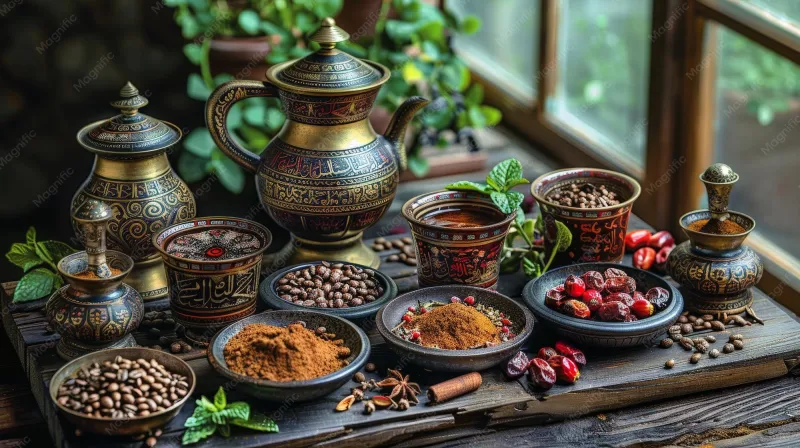
Sfiha, Dolma, and the American Table: Kurdish Cuisine Steps Out of the Home Kitchen and Into the Cultural Conversation
Food is among the most intimate forms of cultural memory. It is also, historically, among the first things a diaspora community risks losing — not through indifference, but through the practical pressures of assimilation, the scarcity of specific ingredients in new geographies, and the gradual fading of the intergenerational transmission that keeps a culinary tradition alive. For Kurdish-American families across the United States, the kitchen has long served as a quiet sanctuary: a place where the flavors of a homeland — whether in Iraqi Kurdistan, southeastern Turkey, northwestern Iran, or northern Syria — could be reconstructed with whatever the local grocery store allowed.
That quiet sanctuary is now, with increasing frequency, opening its doors.
A Cuisine Without a Country — Until Now
Kurdish cuisine occupies a fascinating and underrepresented position in the global food conversation. Shaped by the mountainous terrain and pastoral traditions of the Kurdish homeland, it draws on a remarkable breadth of ingredients and techniques: slow-cooked lamb and goat, fragrant with dried limes and warming spices; rice dishes layered with caramelized onions, saffron, and dried fruits; flatbreads baked in clay ovens and eaten with thickened yogurt and fresh herbs; stuffed grape leaves and vegetables — dolma — prepared with a precision and patience that varies subtly from one family's kitchen to the next.
What Kurdish cuisine has historically lacked is visibility. In a culinary marketplace that has enthusiastically embraced Lebanese, Persian, and Turkish food, Kurdish cooking has remained largely invisible — in part because the Kurdish people have no internationally recognized nation-state, and in part because the diaspora, until recently, has been a relatively small and geographically dispersed community in the United States. Neither of those conditions has fully changed. But the cultural appetite — among both Kurdish-Americans seeking recognition and non-Kurdish Americans seeking new culinary experiences — is creating conditions in which change is becoming possible.
The Entrepreneurs Bringing Kurdish Food to American Tables
In Nashville, Tennessee — home to one of the largest Kurdish communities in the United States — a small but growing number of restaurants and food businesses have begun explicitly marketing Kurdish cuisine to a broader audience. Among them is Zozik Kitchen, a catering operation and pop-up dining experience founded by Nashrin Karim, a Kurdish-American chef who trained in both traditional home cooking and formal culinary arts. Karim's menus center dishes rarely encountered outside Kurdish households: kubba, a bulgur-and-meat dumpling with regional variations that could occupy an entire cookbook on their own; jajik, a cooling yogurt-and-cucumber preparation distinct from its Greek and Turkish cousins; and pacha, a slow-simmered dish of lamb head and trotters that Karim describes as "the dish that separates the curious from the adventurous."
Her pop-up dinners, held monthly at a rotating roster of Nashville venues, regularly sell out. Attendees are a mix of Kurdish diaspora families — many of whom arrive with the specific anticipation of tasting something that tastes like a grandparent's cooking — and non-Kurdish Nashvillians drawn by word of mouth and the city's growing reputation as a food destination.
"People are hungry for food that has a story," Karim has said. "Kurdish food has so many stories. Every dish carries a geography, a season, a memory. I am not just cooking dinner. I am explaining where I come from."
TikTok, Cookbooks, and the Digital Kitchen
Beyond brick-and-mortar and pop-up contexts, Kurdish cuisine is finding a significant and enthusiastic audience through digital platforms. TikTok accounts dedicated to Kurdish home cooking have accumulated substantial followings, with videos of dolma preparation, flatbread baking, and elaborate rice dishes drawing viewers who engage not only with the food itself but with the cultural context provided in captions and voiceovers.
This digital visibility matters for reasons that extend beyond culinary tourism. For younger Kurdish-Americans — many of whom grew up in households where parents or grandparents cooked Kurdish food but did not necessarily transmit the recipes in any formal way — these platforms are functioning as an unexpected form of cultural education. Comments sections on popular Kurdish cooking accounts frequently feature young diaspora members asking detailed questions about technique, ingredient sourcing, and regional variations, initiating conversations that might not have occurred at the family dinner table.
The cookbook space is also beginning to reflect this shift. While a definitive, widely distributed Kurdish cookbook in English remains something of a gap in the American culinary publishing market, several Kurdish-American writers and food bloggers have begun developing manuscript projects, and at least one major food publication has commissioned a feature-length exploration of Kurdish cuisine in the past year — a signal, however modest, of mainstream culinary interest.
Food as Cultural Diplomacy
The political dimensions of Kurdish cuisine's visibility are not incidental. For a people whose cultural identity has been systematically suppressed across multiple nation-states, the act of naming a food tradition as Kurdish — rather than allowing it to be absorbed into the broader categories of "Middle Eastern" or "Mediterranean" — carries genuine significance. Every restaurant menu that identifies a dish as Kurdish, every food festival booth that displays a Kurdish flag alongside its offerings, every cookbook that traces a recipe to a specific Kurdish region is participating in a form of cultural assertion that operates quietly but meaningfully.
American food culture, for all its complicated relationship with authenticity and appropriation, has historically been one of the more accessible pathways through which immigrant communities have achieved broader social recognition. The trajectory from home kitchen to restaurant to mainstream culinary consciousness is a familiar one in American immigration history — and Kurdish-American food entrepreneurs are, with clear eyes and considerable skill, navigating that trajectory on their own terms.
What the Table Offers
There is something worth dwelling on in the particular intimacy of food as a cultural bridge. Unlike language, which requires sustained study to access, or music, which demands a certain openness to unfamiliar sonic conventions, food communicates directly and immediately. A well-prepared plate of Kurdish biryani — fragrant with cardamom and rose water, layered with slow-cooked chicken and jeweled with dried barberries — requires no translation. It asks only that the person sitting across the table be willing to taste something new.
For Kurdish-American communities working to preserve their heritage while building lives in the United States, that willingness — and the generosity required to offer the invitation in the first place — is the foundation of something larger than a meal. It is the beginning of being known.