The Recipe as Relic: Kurdish-American Food Writers Are Turning Grandmothers' Kitchens Into Living Archives
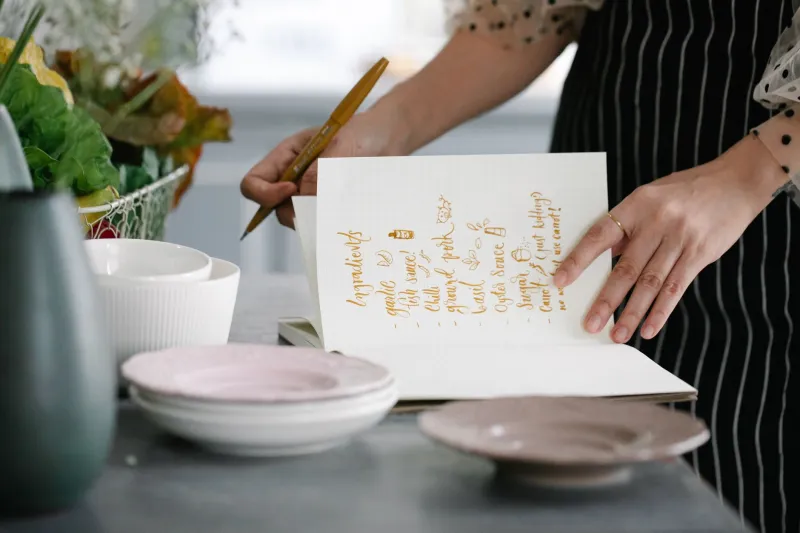
The notebook is water-stained and written in three scripts. On the first few pages, the handwriting belongs to a woman who died before her granddaughter was born. The middle section shifts to a different hand — rounder, more hurried — belonging to the grandmother who carried the notebook out of Iraq in 1996. The final pages, still mostly blank, are being filled in now, in English, by a twenty-nine-year-old in Portland, Oregon, who is trying to figure out what it means to inherit something she never asked for and cannot afford to lose.
Her name is Narin Khalil, and she is, depending on who you ask, a food blogger, a cultural preservationist, a diaspora memoirist, or simply someone who learned to cook because the alternative was forgetting. "I started writing down the recipes because my grandmother was getting older and I was scared," she said. "But the more I wrote, the more I realized I wasn't just writing down measurements. I was writing down a whole world."
Food Writing as Historical Method
What Khalil is doing — and what a growing number of Kurdish-American writers, podcasters, and content creators are doing alongside her — sits at an unusual intersection of culinary documentation and oral history. These are not cookbooks in the conventional sense. They are, in the language of archival practice, primary sources: firsthand accounts of how communities lived, what they valued, where they came from, and what they carried with them when they were forced to leave.
The impulse is not new. Immigrant communities throughout American history have used food as a vector for cultural transmission, and food writing has long served as a form of memoir for people whose more formal histories were never recorded. But what distinguishes this current wave of Kurdish-American food storytelling is both its self-consciousness and its reach. These writers know exactly what they are doing, and they are doing it in public, on platforms — Substack newsletters, Instagram accounts, podcast feeds, YouTube channels — that give their work an audience and, crucially, a permanence that a handwritten notebook tucked in a kitchen drawer cannot guarantee.
The Stakes of the Undocumented Kitchen
To understand why this work feels urgent to those doing it, it helps to understand what is at risk. Kurdish culinary tradition is not a monolith. It varies substantially by region — the food of Erbil differs meaningfully from the food of Mardin, and both differ from the food of the Iranian Kurdish highlands — and it has been shaped by centuries of exchange with neighboring cultures while remaining distinctively its own. It is also, in large part, an oral tradition. Recipes were not typically written down. They were demonstrated, adjusted, tasted, and passed hand to hand across generations of women who learned by standing next to someone who already knew.
When displacement interrupts that chain of transmission — as it has, catastrophically, for Kurdish communities across the Middle East over the past several decades — what is lost is not just a set of instructions. What is lost is the context: the knowledge of which wild herbs grew on which hillside, which spice combination marked a feast day versus an ordinary Tuesday, which dish was made for mourning and which for celebration.
"My mother can make dolma in her sleep," said Layla Hassan, a Chicago-based podcaster whose show, Sofra Stories, documents Kurdish and broader Middle Eastern food traditions through extended conversations with home cooks. "But she has never once measured anything. She doesn't know how to explain it in a way that I could replicate without her standing next to me. That's the gap I'm trying to close — not just for myself, but for everyone who has the same gap."
The Digital Platform as Archive
What social media and digital publishing have made possible, in ways that previous generations of diaspora food writers could not have anticipated, is the creation of a distributed, searchable, shareable archive that exists outside of any single household or institution. When Khalil posts a recipe for qeymeh on her Substack, annotated with her grandmother's notes about the particular sourness of the pomegranate paste available in the Sulaymaniyah bazaar, she is not just feeding her subscribers. She is depositing a document into a collective record that anyone with an internet connection can access.
This is not lost on the writers themselves. Several have begun using their platforms explicitly as archival projects, tagging their posts with geographic and historical metadata, partnering with Kurdish cultural organizations to ensure their content is preserved beyond the lifespan of any given platform, and actively soliciting contributions from community members who have their own recipes, their own stories, their own water-stained notebooks.
"I think about the people who will read this in twenty years," said Soran Bakr, a food writer based in Nashville who has been documenting the cuisine of Kurdish communities in southeastern Turkey. "Maybe they'll be Kurdish-American kids who grew up here and never tasted any of this. Maybe they'll be researchers who want to understand what this community was. Either way, I want them to have something real — not just a list of ingredients, but a sense of the life that surrounded the food."
Resistance on the Plate
There is also, woven through much of this work, a dimension that is explicitly political — though the writers themselves often resist that framing, preferring words like witness or testimony. The documentation of Kurdish food traditions is, in the context of a people whose cultural existence has been systematically suppressed across multiple nation-states, an inherently resistant act. To name a dish in Kurmanji, to trace its origins to a specific village, to insist on its distinctiveness from the national cuisines of countries that have often denied Kurdish cultural specificity — these are not neutral gestures.
"Every time I write about Kurdish food as Kurdish food — not as 'Middle Eastern food,' not as a regional variation of something else — I'm making an argument," Khalil said. "I'm saying: this is a culture. It has a name. It has a history. It deserves to be recorded on its own terms."
The notebook in Portland continues to fill. The recipes multiply. The archive grows.