The Quiet Curriculum: What Kurdish-American Grandmothers Teach That No Classroom Ever Could
Long before formal mentorship programs and cultural competency workshops entered the American mainstream, Kurdish grandmothers were already running their own academy — one conducted in whispered advice, shared meals, and the patient art of watching. Their lessons, unwritten and largely invisible to outsiders, form the connective tissue between two worlds that their grandchildren must learn to inhabit simultaneously.
In Kurdish households across Nashville, San Diego, and the suburbs of Detroit, these women occupy a role that resists easy translation. They are not simply caregivers. They are not merely tradition-keepers in the ceremonial sense. They are, in the most precise meaning of the phrase, strategic advisors — women who have survived displacement, navigated immigration bureaucracies, raised children in countries whose languages they had to learn in middle age, and emerged with a form of practical intelligence that no university curriculum has yet found a way to certify.
Knowledge Earned, Not Assigned
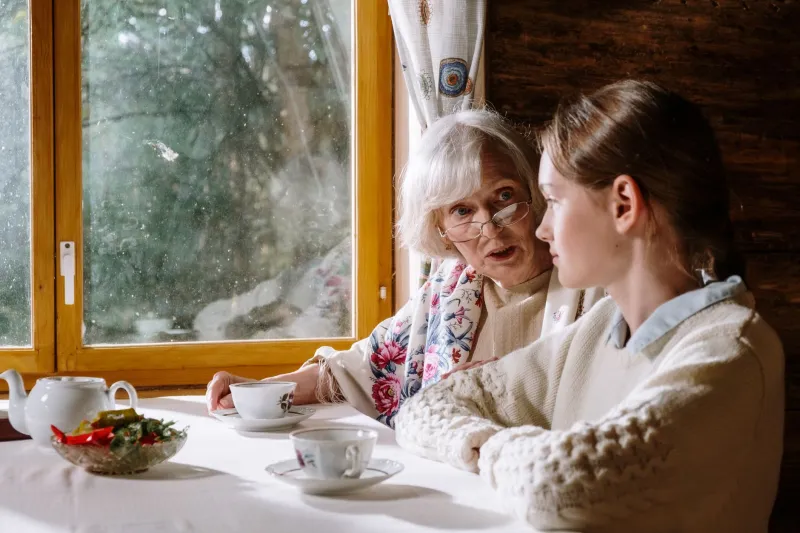
Nadia, a twenty-six-year-old Kurdish-American graduate student in Chicago, describes her grandmother's counsel as "the operating manual I didn't know I needed." When Nadia was preparing for her first job interview out of college, her grandmother — who had never held formal employment in the United States — sat with her for two hours and talked through the unspoken social codes of American professional environments: how to dress in a way that signals competence without erasing identity, how to answer questions about one's background without performing either apology or overexplanation, how to read a room before deciding how much of yourself to reveal.
"She had watched my aunts navigate workplaces for twenty years," Nadia explains. "She had listened to every frustration, every story of being misread or overlooked. She had processed all of that and distilled it into something I could actually use."
This is the grandmother's curriculum: accumulated, observational, and deeply relational. It does not arrive in syllabi or structured sessions. It surfaces in the kitchen while bread is being made, during long car rides, in the margins of family gatherings when the older woman pulls a younger one aside and speaks quietly, directly, and without the softening that formal mentorship often employs.
The Architecture of Dual Expectations
Perhaps the most sophisticated dimension of this informal education concerns the management of dual cultural expectations — the daily negotiation that Kurdish-American young people face between what their families and communities require of them and what American institutions demand. Grandmothers, who have themselves lived this negotiation for decades, are often its most fluent interpreters.
Sarya, a high school counselor in Nashville whose own grandmother immigrated from the Dohuk region of Iraqi Kurdistan in the early 1990s, recalls being taught what she calls "the art of the translation." Not linguistic translation, but something more nuanced: the ability to explain a Kurdish cultural value or family obligation to an American employer or school administrator in terms those institutions could recognize and respect, without flattening or misrepresenting its original meaning.
"My grandmother used to say, 'You don't have to choose between who you are and where you are. You have to learn to speak both languages at the same time,'" Sarya recounts. "She wasn't talking about Kurmanji and English. She was talking about ways of being in the world."
This kind of double fluency — cultural rather than linguistic — is one of the grandmothers' most consistently transmitted gifts. It reflects a hard-won understanding that assimilation and preservation are not opposites, but rather a tension to be managed with skill and intentionality.
Survival Tactics Dressed as Tradition
Not all of the grandmother's curriculum is explicitly framed as strategic advice. Much of it arrives disguised as cultural practice — the doing of things in particular ways for reasons that seem, on the surface, purely traditional. But younger Kurdish-Americans who have paid close attention often describe realizing, in retrospect, that the traditions themselves contained embedded instructions for survival.
The insistence on hospitality, for instance — the Kurdish cultural imperative to welcome guests with generosity regardless of personal circumstance — carries within it a lesson about community-building that has direct practical value in the American context. Grandmothers who taught their grandchildren to maintain this practice were, simultaneously, teaching them how to cultivate the social networks that would support them when institutions failed to do so.
Similarly, the emphasis on discretion — on knowing what to share publicly and what to hold privately — reflects a survival intelligence shaped by generations of living under conditions in which visibility carried risk. Kurdish grandmothers who grew up in regions where Kurdish identity was criminalized or suppressed carry within them an acute understanding of when to speak and when to withhold. In the American context, this translates into a sophisticated awareness of how identity is read and weaponized by different audiences, a form of social intelligence that their grandchildren are only beginning to recognize as the gift it is.
The Weight of Being a Keeper
It would be incomplete to romanticize this role without acknowledging its costs. The grandmothers who carry this knowledge often carry it alone, without recognition, and without rest. Many have never been asked to articulate what they know. Some have watched their guidance go unheeded, only to see grandchildren return years later, humbled and ready to listen. Others have felt the particular grief of watching younger generations absorb American frameworks so thoroughly that the grandmother's wisdom begins to seem, to those same grandchildren, like superstition or overprotection rather than hard-earned intelligence.
Leila, seventy-three, who arrived in the United States from southeastern Turkey in 1998 and now lives with her son's family in a suburb of San Diego, speaks of this with characteristic directness. "They think I don't understand their world," she says. "But I understand it better than they know. I just have to wait for them to be ready to hear it."
That patience — the willingness to hold knowledge until the moment it can be received — may be the grandmother's most undervalued skill. It requires a long view, a confidence in the value of what one carries, and a trust that the relationship will eventually create the conditions for transmission.
Honoring What Refuses to Be Institutionalized
American culture has a tendency to formalize and systematize forms of knowledge it considers valuable — to package them into workshops, certifications, and programs. The wisdom of Kurdish grandmothers resists this. It is, by its nature, relational, contextual, and alive. It changes shape depending on who is receiving it and what they need. It cannot be fully captured in a book or a curriculum, because its power lies precisely in the relationship through which it travels.
What Kurdish-American communities can do — and what some are beginning to do — is create the conditions under which these transmissions are more likely to occur: intergenerational gathering spaces, oral history projects that center elder women's voices, community practices that bring grandmothers and young people into sustained proximity rather than occasional contact.
The grandmothers are still teaching. The question is whether their students — and the broader communities that surround them — are paying close enough attention to learn.